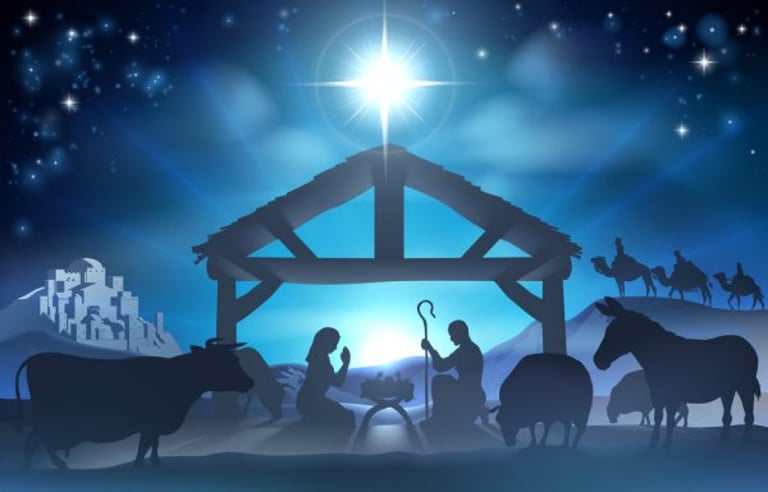
How to Create a Traveling Wise Men Nativity: Build the Journey to Bethlehem
Create a traveling Wise Men Nativity with Magi, camels, animals, the Star and a route to Bethlehem, then move the Three Kings toward the manger.
Grace Callahan
10/8/202613 min read


The Wise Men don't have to spend the entire Christmas season standing beside the manger.
Instead, they can begin some distance away and gradually travel through a miniature landscape toward Bethlehem. Add camels or other animals, a few rocks and trees, perhaps a stream or well, and suddenly three Nativity figures become part of a much larger story.
The display can be simple. Three Wise Men might move across a mantel toward the Holy Family over several weeks.
Or you can build an entire route with mounted Magi, animals, terrain, palm trees, pathways and buildings that gradually lead toward Bethlehem.
The important idea is the same:
Give the Wise Men somewhere to start, a journey to travel and Bethlehem as their destination.
And because the display can be expanded a piece at a time, you don't need to build the entire landscape at once.
Table of Contents
What Is a Traveling Wise Men Nativity?
A traveling Wise Men Nativity separates the Magi from the manger and uses their movement toward Bethlehem as part of the Christmas display.
Instead of placing all of the Nativity figures together immediately, the Holy Family remains at the destination while the Wise Men begin somewhere else.
Over time, the Magi move closer.
In a small display, that may mean moving three figures from one end of a mantel to the other.
With more space, you can create a recognizable journey using animals, landscaping and miniature structures.
The display might begin with the Wise Men crossing relatively open terrain. Farther along the route, trees, a stream or a well can create landmarks. Buildings can begin appearing as the travelers approach Bethlehem. Finally, the route reaches the Nativity.
This does more than add decorations around the manger.
It turns the space between the Wise Men and the Holy Family into part of the scene.
Start With the Destination: Bethlehem
Build the journey backward.
Start with the Nativity you already have and decide where it will remain during the season. That becomes Bethlehem and the destination for everything else.
You don't necessarily need an elaborate village.
A stable with Mary, Joseph and Baby Jesus can provide a perfectly clear destination.
If you have more room, a stable, house, inn or another appropriately scaled structure can make the Bethlehem end of the display visually different from the more open landscape along the journey.
That difference is useful.
The Wise Men should appear to be traveling toward somewhere, rather than simply moving across a collection of unrelated decorations.
You don't need another building if your existing Nativity already establishes the destination clearly.
The goal is to make Bethlehem visually recognizable from the beginning of the route.
Decide Where the Wise Men Begin Their Journey
Now look for the opposite end of the display.
The starting point should be far enough from the Nativity that the Wise Men can visibly make progress.
On a mantel, that might simply mean opposite ends.
On a large table, the Magi might begin diagonally across the scene.
A Christmas village can provide considerably more room. The Wise Men might begin beyond the village and gradually enter it.
You can even create a journey between separate display surfaces if the arrangement of your room makes that practical.
Don't make the route unnecessarily complicated.
What matters is that someone looking at the display can understand:
The Wise Men are over here. Bethlehem is over there. They are traveling toward it.
Once those two points are established, you can begin filling in the space between them.


Choose Wise Men That Look Like Travelers
Almost any appropriately scaled Magi figures can be used in a traveling display, but some poses communicate movement better than others.
Standing Wise Men are the simplest choice. If you already own them, there's no reason to replace them merely to create the journey.
A group designed around the journey can make the concept even clearer. The Three Kings Gifts Following the Star Wise Men Nativity Set is particularly well suited to this kind of display because the figures can function as travelers before becoming part of the completed Nativity.
Mounted Wise Men make the travel theme more obvious.
The Village Gift Importers Three Kings Riding Camels immediately creates the appearance of a procession and can cover more visual space than three standing figures.
There are also more unusual combinations. The Love's Gift Three Wise Men on Animals places the kings on a horse, elephant and camel, creating a varied caravan rather than three identical mounts.
You don't need mounted figures, however.
If you already own Magi that work with your Nativity, use them. The landscape and changing placement can communicate the journey.
If you haven't chosen the figures yet, How to Add Wise Men to an Existing Nativity Scene explains how to match their scale, proportions and artistic style to a Nativity you already own.


Build a Caravan With Camels and Other Animals
Animals can turn three traveling figures into a caravan.
Camels are the most familiar choice, and they can be especially useful when the Wise Men themselves are not mounted.
A separate Fontanini Standing Camel can trail behind or accompany the Magi. A Fontanini Seated Camel can create a stopping point along the route rather than making every animal appear to be moving at the same time.
That variation can make a larger scene look more natural.
Horses and elephants provide additional possibilities when they fit the style and scale of the scene.
An elephant can make a particularly striking caravan figure, but its presence in Nativity art comes from later traditions surrounding the Magi rather than from the biblical account itself.
If you're considering one, Why Is There an Elephant in Some Nativity Scenes? Tradition, Meaning and How to Add One explains how elephants became connected with Three Kings imagery.
Don't feel obligated to create an enormous caravan.
Three Magi and one camel can communicate travel perfectly well.
The purpose of additional animals is to make the journey more interesting, not to fill every available inch.


Create the Ground and Terrain
This is where the display can change dramatically without requiring expensive pieces.
The surface underneath the figures helps establish whether you're looking at a row of figurines on furniture or a miniature landscape.
And it doesn't necessarily need to be sold as a Nativity product.
A Natural Coconut Coir Terrain Mat can provide a neutral earth-colored base for part of the journey. Once rocks, animals and figures are placed on top, the product's original seasonal marketing matters far less than its appearance in the finished scene.
Products sold for miniature villages, dioramas or other seasonal displays can sometimes work just as well as Nativity-specific scenery, provided their scale, appearance and materials suit your display.
You don't have to cover the entire display surface.
A strip of terrain can suggest a route. Several irregular pieces can create different landscape zones. Leaving some areas uncovered can help distinguish the journey from Bethlehem.
Avoid making the surface too visually busy.
The terrain should support the figures rather than competing with them.


Add Trees, Rocks and Other Landmarks
One of the easiest ways to make the Wise Men's movement noticeable is to give them landmarks to pass.
Rocks are particularly useful because they're inexpensive, easy to reposition and don't dictate exactly how the display must be arranged.
A set of Miniature Diorama Rocks can define a bend in the route, create a small rise or simply provide a recognizable point that the Wise Men move beyond.
This is also a good example of why Nativity builders don't need to shop exclusively for products labeled “Nativity.” Generic miniature scenery can sometimes provide exactly the feature the display needs.
Trees create taller landmarks.
A Three Kings Gifts Bethlehem Palm Tree can visually separate one stage of the journey from another, while the Fontanini Palm Tree 3-Piece Set provides several trees for a larger collection-scale landscape.
You don't need a forest.
One or two well-placed trees can be more useful than covering the scene with vegetation.
They can also make the movement more obvious:
One week the Magi are before the palms.
Later they're beside them.
Then they're beyond them and closer to Bethlehem.
The landscape becomes a measuring stick for the journey.


Use Streams, Bridges and Wells to Create a Route
A more elaborate display can use landscape features to divide the journey into recognizable stages.
A stream is particularly effective because it naturally creates a boundary.
A Nativity Stream and Bridge can give the caravan something to approach, cross and eventually leave behind.
You don't have to move the Wise Men every day for this to work.
A few meaningful positions can tell the story:
Before the stream.
At the crossing.
Beyond the bridge.
Approaching Bethlehem.
A well can perform a similar job without requiring as much landscape space.
A Miniature Village Water Well positioned closer to Bethlehem can signal that the travelers are approaching a settled area.
The key is restraint.
Don't add a bridge because miniature bridges are attractive. Add it because it helps create a route.
Don't add a well simply to fill an empty corner. Use it as a landmark.
Every feature should make the journey easier to see.


Add Buildings as the Wise Men Approach Bethlehem
The landscape can gradually change as the Magi get closer to their destination.
The beginning of the route might contain mostly terrain, rocks and vegetation.
Then a well appears.
Then perhaps a wall, house, workshop or other structure.
Finally, the travelers reach the Nativity.
This creates a visual transition from open landscape to settlement to Bethlehem.
You don't need an entire miniature town. One appropriately scaled structure can begin signaling that the travelers are approaching a settled area.
For a larger collection-scale display, the Fontanini Farmhouse with Water Mill illustrates how a substantial structure can transform the destination from an isolated manger into part of a broader village environment.
Collectors who want a more elaborate display have considerably more possibilities. Buildings, workshops, houses, mills and other structures can turn the area around the Nativity into a village rather than a single isolated stable.
This is where expandable systems become particularly interesting.
If you enjoy adding to the scene from year to year, the journey can grow with the collection rather than being rebuilt from scratch every Christmas.
Start with the Magi and a few landmarks.
Add another building next year.
Add landscaping later.
Eventually, a simple traveling-Wise-Men tradition can become a substantial Bethlehem display.
Use the Star to Point Toward the Destination
The Star can visually connect the entire display.
Instead of treating it simply as decoration above the stable, think about what it tells someone looking at the scene.
The Wise Men are traveling in one direction.
The Star identifies where that journey leads.
That relationship becomes especially useful in a long display because the Star can visually connect figures that may be several feet from the Holy Family.
You don't need multiple stars marking a literal pathway.
One clear focal Star near or above Bethlehem is usually enough.
Then orient the Wise Men and their caravan toward it.
That simple visual relationship can make a collection of separate figures, animals and scenery read as one story.
For more about the Star itself and its role in the Nativity story, see The Star of Bethlehem: A Beacon of Hope in the Nativity
How to Move the Wise Men Through the Display
There is no requirement to move the Magi according to an elaborate schedule.
Choose a rhythm your household will actually enjoy.
You might move them every few days.
Children might take turns moving them.
Or you might move the caravan only at several major points during the Christmas season.
What matters visually is that each move represents real progress.
If the Wise Men move only an inch across a large landscape, nobody may notice.
Instead, use the scenery.
Move them from the starting area to the rocks.
Then toward the palms.
Then to the stream or bridge.
Then toward the well or first buildings.
Finally, bring them into Bethlehem.
The landmarks make each stage obvious and give the movement a sense of purpose.
If you're interested in the biblical journey behind the display, Journey of the Three Wise Men: Route, Distance and What We Really Know explores what the Gospel account says and how the familiar Magi tradition developed.
How Much Space Does a Traveling Wise Men Display Need?
Much less than you might think.
The smallest version requires only enough room to separate the Magi from the Holy Family.
A mantel, shelf or tabletop can be sufficient.
Larger displays need more planning because the animals and scenery consume space quickly.
Mounted Magi require more room than standing figures.
A caravan requires more than three kings alone.
A stream or bridge requires enough space to remain recognizable.
Buildings can create significant height and depth.
Before buying larger pieces, measure the display surface and the figures you already own.
Scale becomes especially important when scenery is involved.
A beautiful bridge that visually towers over the Magi may look more like a monument than something on their route. A tiny building beside large figures can create the opposite problem.
Nativity Figure Sizes and Scale: How to Match New Figures, Animals, Stables and Accessories explains how to compare people, animals, structures and accessories before adding them to the same scene.


Build the Journey a Little at a Time
One of the advantages of this kind of Nativity is that it doesn't need to be finished in one shopping trip.
Start with what you already have.
If you own the Holy Family and Wise Men, separate them.
You've created the beginning and destination.
Then identify what's missing.
Maybe one Standing Camel is enough to make the Wise Men look like travelers.
Perhaps a few Miniature Rocks are the next improvement.
A Palm Tree can become another landmark.
Later you might add a Stream and Bridge, Water Well or Bethlehem Building.
This approach has two advantages.
First, the display grows according to the space you actually have rather than according to a shopping list.
Second, every new piece has a purpose.
You're not collecting accessories because they exist.
You're building a landscape because you know where each addition belongs in the story.
Over several Christmas seasons, that can produce a much more personal display than purchasing a large finished scene all at once.
When the Wise Men Arrive at Bethlehem
Eventually the journey reaches its destination.
If your Magi match the scale and style of the Holy Family closely, you can bring them directly into the central Nativity grouping.
Mounted Wise Men and larger caravans may need a different arrangement.
The kings can approach the Holy Family while the animals remain slightly farther away. A large elephant or several camels don't need to be squeezed immediately beside the manger simply because the journey is complete.
The landscape can remain in place too.
The empty route now shows where the travelers came from.
Rocks, trees, bridges, wells and buildings that helped mark their progress become part of the completed Bethlehem scene.
That's one of the most interesting things about building the journey rather than simply moving three figures.
When the Wise Men arrive, you haven't just changed their location.
You've created an entire Nativity landscape around them.
Frequently Asked Questions
When should the Wise Men be moved to the Nativity?
There are different household and cultural traditions for displaying and moving the Magi. Some families place them away from the manger during Advent or Christmas and bring them closer over time, with their arrival associated with Epiphany. You can adapt the movement to the tradition your household follows.
Do I need special traveling Wise Men figures?
No. Ordinary standing or kneeling Magi can be moved through the display. Mounted figures simply make the idea of travel more visually obvious.
Can I use miniature scenery that isn't specifically made for Nativities?
Yes. Generic miniature terrain, rocks, vegetation and other scenery can work if the appearance and scale suit your Nativity. Pay more attention to how the piece looks with your figures than to the category in which it is marketed.
Do I need camels for a traveling Wise Men Nativity?
No. Camels can strengthen the caravan appearance, but the biblical account does not specify that the Magi traveled by camel. They are a longstanding part of later Nativity imagery and tradition.
Can I include an elephant or horse in the Magi caravan?
You can if those animals fit the artistic tradition and scale of your display. Horses and elephants appear in some later depictions of the Magi, although the Gospel account doesn't identify their transportation.
How large does the journey need to be?
It can be only a few feet—or even less. What matters is having enough separation between the Magi and the manger for their movement to be noticeable.
Do I need to move the Wise Men every day?
No. Moving them periodically between recognizable landmarks can make the journey easier to follow than making tiny daily movements.
Can I add buildings around the Nativity?
Yes. A stable may be enough to establish Bethlehem, while houses, wells, workshops and other structures can create a larger village environment if your display space and figure scale support them.
Continue Reading
How to Add Wise Men to an Existing Nativity Scene
Before beginning the journey, learn how to choose Magi that work with the size, proportions and style of a Nativity you already own.
Journey of the Three Wise Men: Route, Distance and What We Really Know
Explore the biblical account and traditions behind the journey you're recreating in your display.
Nativity Figure Sizes and Scale: How to Match New Figures, Animals, Stables and Accessories
Learn how to combine people, animals, buildings and scenery without making parts of the display look noticeably oversized or undersized.
Journey of the Three Wise Men: Route, Distance and What We Really Know
Discover why elephants became associated with the Magi and why they appear in some Three Kings processions and Nativity traditions.
The Star of Bethlehem: A Beacon of Hope in the Nativity
Learn more about the Star that provides the visual destination for your traveling Wise Men display.
“As an affiliate marketer, I earn from qualifying purchases with no added cost to you.”
© 2024. All rights reserved.